
Accredited by the National Board of Accreditation (NBA) under Tier-I
Academic spaces supporting effective teaching, experimentation, and innovation
The Department of Electronics and Communication Engineering is supported by modern infrastructure that enhances the teaching–learning process and research activities. Well-designed classrooms, advanced laboratories, and specialized research facilities provide students with a conducive environment for experiential learning, innovation, and skill development in core and emerging areas of electronics and communication engineering.
The department has spacious, well-ventilated classrooms equipped with modern teaching aids to support effective learning and student engagement.
Â

The Signal Processing Laboratory provides hands-on exposure to the analysis and processing of signals using modern tools and techniques. Students perform experiments related to sampling, filtering, convolution, correlation, Fourier transforms, and spectral analysis. The lab strengthens practical understanding of digital signal processing concepts through simulations and real-time signal analysis.
Major Equipment Available
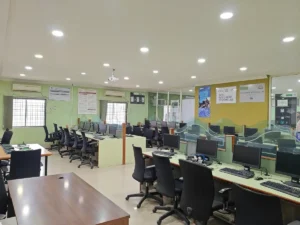
This laboratory is designed to give students practical experience in programming and interfacing microprocessors and microcontrollers. Experiments include assembly and embedded C programming, peripheral interfacing, interrupt handling, and real-time applications. The lab bridges the gap between hardware and software in embedded system design.
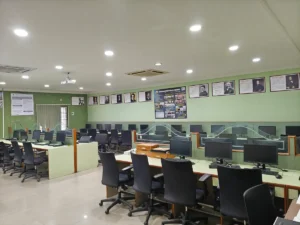
The Advanced Communications Laboratory focuses on modern communication systems and techniques. Students work on experiments involving digital modulation, multiple access techniques, channel coding, error detection and correction, and wireless communication concepts. The lab emphasizes simulation and analysis of advanced communication models.
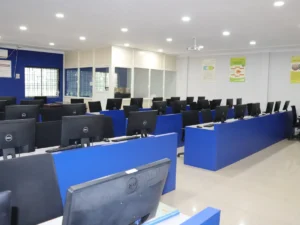
The VLSI Design Laboratory provides practical training in the design and verification of integrated circuits. Students gain experience in CMOS logic design, schematic entry, layout design, timing analysis, and simulation using industry-standard EDA tools. The lab prepares students for careers in semiconductor and VLSI industries.
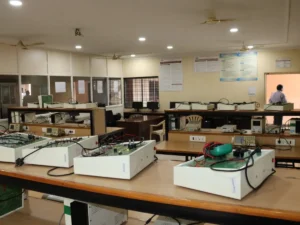
This laboratory offers hands-on experience with both analog and digital communication systems. Experiments cover AM, FM, PCM, ASK, FSK, PSK, and noise analysis. Students learn the practical aspects of signal transmission, reception, and performance evaluation in communication systems.
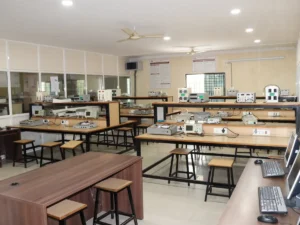
The Integrated Circuits Laboratory focuses on the study and application of linear and nonlinear ICs. Students perform experiments using operational amplifiers, timers, voltage regulators, and other ICs to design amplifiers, oscillators, filters, and waveform generators. The lab enhances practical circuit design and troubleshooting skills.
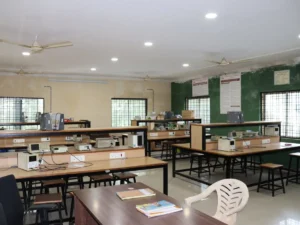
This laboratory provides hands-on exposure to electronic devices and basic circuit analysis. Experiments include the study of diodes, BJTs, MOSFETs, rectifiers, amplifiers, and biasing circuits. The lab helps students understand device characteristics and apply theoretical concepts to real-world electronic circuits.
The C-CARL is one of the major research center in Vardhaman College of Engineering that was established in the year 2012 with objectives of
The objective of this center is to empower the faculty and students of VLSI stream. The C-CARL helps in implementation of the Circuit Level, Process Level and Device Level designs for complex analog and digital circuits.
The C-CARL is equipped with Cadence Tool (20 Users UG Bundle and 20 Users Research Bundle). Cadence software is the industry standard tool for chip designing. C-CARL research group focuses on the development of VLSI projects from RTL to GDS-II.
The following are the Outcomes of VLSI Design stream:
Improvise the research work, file patents, submit research proposals under various funding agencies both private and Government
The Center for Research in Automation, IoT, and Smart Embedded Systems (C-RAISE) at Vardhaman College of Engineering, established in the academic year 2015–16, has emerged as a premier hub for research, innovation, and industry collaboration. Conceived to address the growing technological challenges in automation, embedded intelligence, and IoT ecosystems, the Centre has evolved into a dynamic and future-ready environment. By supporting advanced academic research, interdisciplinary development, and industry-driven skill building, C-RAISE plays a strategic role in elevating institutional research capacity and driving impactful technological contributions.
Vardhaman College of Engineering has established a research center in signal processing in the academic year 2015-16 with the goal of undertaking fundamental research in signal processing and communication engineering. Research, at theoretical and applied levels, is conducted in this center. This Center offers multidisciplinary research programs.
The field of Signal Processing and Communications is a very important field of study in terms of phenomenal advances and attainments both on research and applications fronts. In the present era of computer revolution, the Automatic Speech Recognition (ASR) plays a major role in enhancing the user experience, in a natural way, while communicating with the machines.